

What your customers are saying, sorted and sourced
Brand Listener reads reviews, marketplaces, video comments, forums and news, then turns what people say into themes, sentiment, share of voice and the places where sources disagree.
AI reads and themes the raw text at a volume no manual coding pass could match; every theme and sentiment reading still carries its signal tier and its source channel.
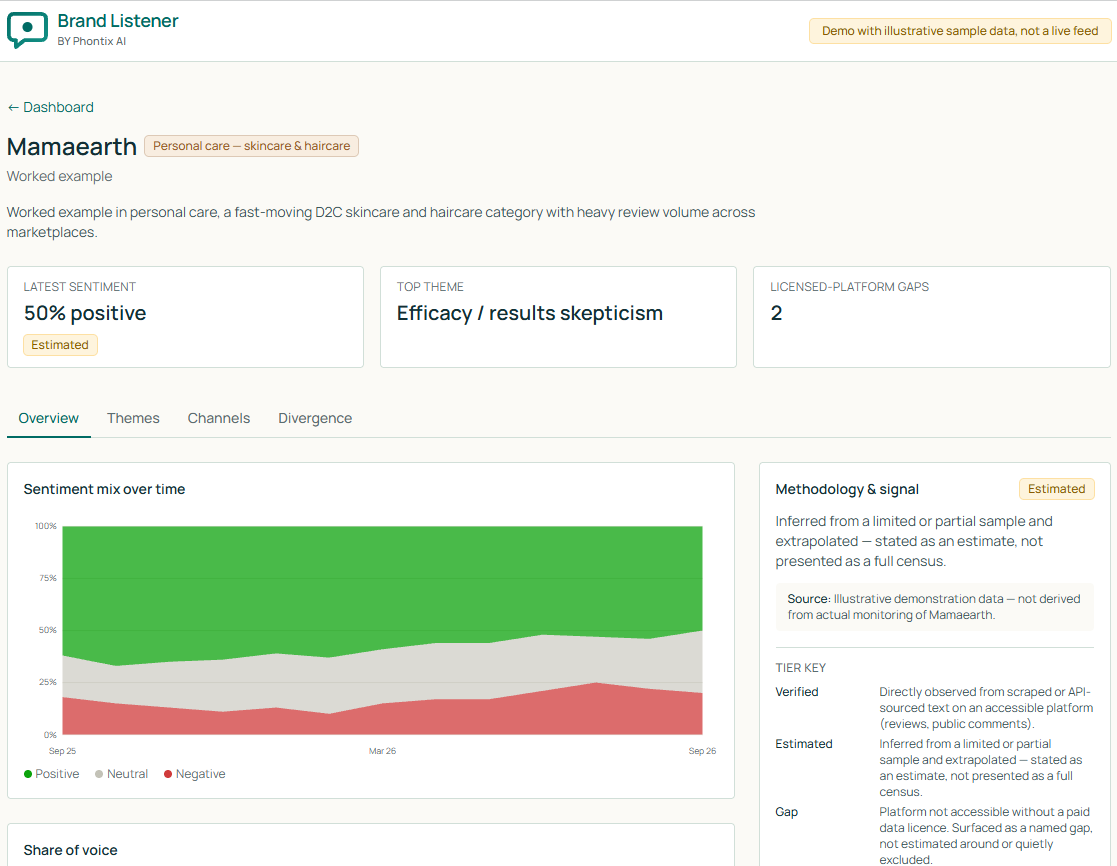

Your brand is being discussed in places you are not reading
The first sign that a product is losing ground rarely shows up in a sales report. It shows up in review text, in a listing that quietly repriced, in a change in what people complain about.
Brand Listener monitors those sources for your brands and your competitors', then turns unstructured text into a structured view: sentiment by theme, share of voice, rising complaints and the channels driving them. Complaints that are growing are separated from complaints that are simply present.
Where the signals come from
Eight channels, each with an honest access tier and a note on whose voice it carries. What we cannot read is shown as a gap, not modelled around.
| Channel | Whose voice | Access | What it gives |
|---|---|---|---|
| E-commerce reviews (Amazon, Flipkart, Nykaa) | Customer | Open | Verified-purchase review text with ratings. The closest thing to a census of buyer opinion. |
| Google Reviews | Customer | Open | Public structured reviews of outlets and services. |
| YouTube comments | Customer | Open | Unprompted reactions under reviews, tutorials and brand content. |
| Customer | Restricted | Long-form comparison threads with the full comment tree, where people explain why they switched. Read at a controlled rate and sampled, so readings are marked estimated. | |
| Other forums and community threads | Customer | Restricted | Readable but rate-limited at scale. Sampled and marked estimated. |
| News and blog mentions | Press | Restricted | Available through news services, most paid beyond a low free tier. |
| X (Twitter) | Customer and brand | Licensed | A named account’s own timeline and its replies are readable directly. Keyword search across all public posts needs a paid data licence, offered as an add-on. |
| Instagram and Facebook | Brand | Owned only | Verified business access returns your own accounts, their engagement, and posts that mention or tag you. Posts and comments about your brand that you do not own cannot be retrieved at any price, by us or by anyone selling you Instagram listening. |
What you get
Readings your brand, insights and e-commerce teams can act on this week.
Sentiment over time
Positive, neutral and negative mix by month, so a shift shows up before it reaches sales data.
Share of voice
Your share of the conversation against a named competitor set.
Ranked themes
What people discuss, ranked by share, with trend direction and sentiment split per theme.
Channel view
Volume and sentiment by channel, with each channel's access tier and signal tier.
Divergence
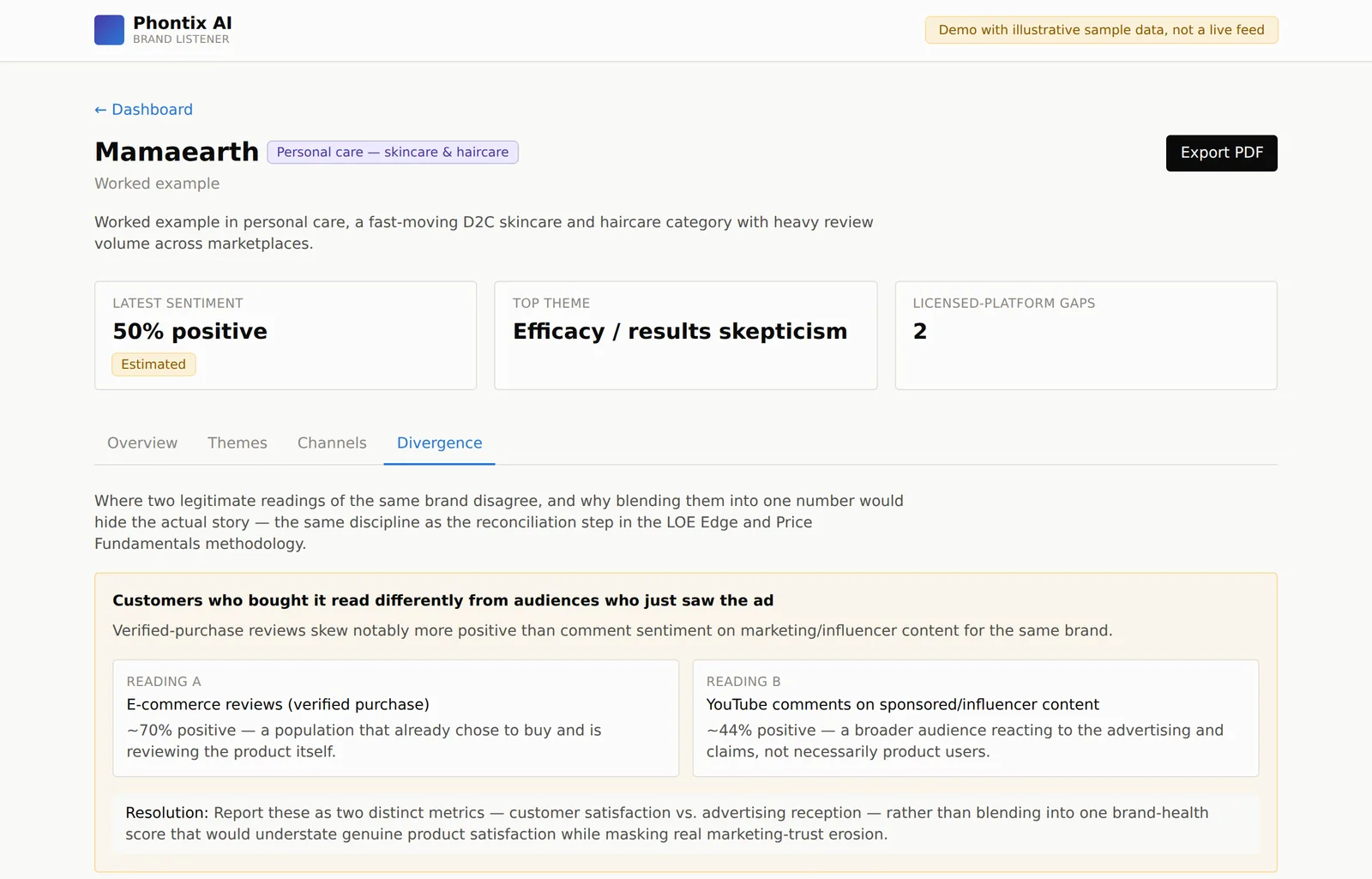
Named cases where two sources disagree, reported as two numbers with an explanation.
Brand dossiers
A PDF dossier per brand for offline review and internal circulation.
Signal tiers, and why we never blend them
Every reading carries one of three tiers.
- Verified
- Directly observed on an accessible platform, such as structured reviews and public comments.
- Estimated
- Inferred from a limited sample and stated as an estimate, not a census.
- Gap
- A platform we cannot read without a paid licence, shown as a named gap.
When verified buyers and general audiences disagree about a brand, one blended score hides the most useful fact on the page. We report both.
Read the Brand Listener methodologyWho it is for
Teams at CPG, FMCG and consumer-facing brands, wherever customers leave reviews, ratings and comments.
Brand managers
Brand health and share of voice against the competitors you actually lose sales to.
Insights teams
Emerging themes and complaints, with the evidence behind each one.
E-commerce and revenue managers
Ratings, listing quality and review signals by marketplace.
Download a sample brand dossier
Personal care worked example, PDF. Synthetic data for demonstration.
Discuss access to Brand Listener
Tell us about your team, markets and coverage needs. Contact our sales team to discuss pricing and the right access for you.
Talk to salesCommon questions about Brand Listener
Which sources does Brand Listener read?
E-commerce reviews, Google Reviews and YouTube comments are open and read directly, and they carry customer voice. Reddit and other community forums are readable but rate-limited, so they are sampled and marked as estimated rather than presented as a census. News and blog mentions come through news services. X requires a paid data licence for full keyword search, offered as an add-on; a named account and its replies are readable without it. Instagram and Facebook return your own accounts and anything that tags or mentions you, which is brand voice rather than customer voice.
Can you tell us what people are saying about our brand on Instagram?
Only where they have tagged or mentioned you. Meta does not make posts and comments about a brand searchable to anyone outside the account that owns them, and no licence, tier or vendor changes that. What Brand Listener reports from Instagram is your own content, its engagement, and mentions that reach you, all labelled as brand voice. If a vendor is quoting you an Instagram sentiment score for your category, ask which posts it was computed from. Customer voice for consumer brands sits in reviews, YouTube comments and Reddit, and that is where we read it.
How is sentiment scored?
By theme rather than as one aggregate, because a brand can be praised on one attribute and criticised on another. The scoring method is documented and consistent across brands, so comparisons hold.
Can we track competitors?
Yes. Competitor sets are configured per plan, and most of the value sits in the comparison rather than the absolute number.
What happens when sources disagree?
We report both readings with an explanation instead of blending them. Verified buyers and general social audiences often feel differently about the same brand, and that difference is usually the finding.
Which kinds of brands is it for?
Brands that sell to consumers: CPG and FMCG, D2C and other consumer-facing products, wherever customers leave reviews, comments and ratings.
Run it on your brand and two competitors
A demo takes your brand set and shows what the last thirty days of public signal actually said.