

Find the exclusivity events worth developing for
Patent layers, regulatory exclusivity and challenge activity, resolved into a ranked view of which exclusivity events are actually worth acting on. Every entry carries its source, and you can trace the reasoning behind the ranking yourself. For generic and biosimilar manufacturers deciding what to develop next, and for innovators who need to see a patent cliff coming rather than react to it.
AI surfaces the candidate filings and prepares the ranked view; every output still carries its source and confidence tier so you can check the reasoning yourself.

What is loss of exclusivity tracking?
Loss of exclusivity tracking follows the point at which a medicine's protection ends in each market, and estimates when generic or biosimilar competition will really arrive and what it will be worth.
Knowing that a patent expires is the easy part. The hard part is knowing which expiries turn into competition, when, in which markets and with how many entrants. That answer sits across patent registers, regulatory exclusivity, challenge filings, treatment data and pricing records that were never designed to be read together.
LOE Edge reads them together, keeps each input tied to its source, and grades how much weight every number can bear.
Built for teams choosing targets, useful to teams defending them
The same expiry is an opportunity for one company and a threat to another. LOE Edge gives each side the view it needs.
If you are selecting generic or biosimilar targets
- See the true entry date across every layer of protection, not just compound patent expiry
- Screen upcoming expiries by opportunity size and how crowded the challenge activity is
- Compare exclusivity and entry routes across the US, EU5 and India
- Size the post-exclusivity opportunity to 2035, with the working behind each figure
- Prioritise a development pipeline against capacity and launch timing
If you are defending a branded product
- Early warning when challenge activity appears against your molecules
- A market-by-market erosion outlook with assumptions you can change
- Lifecycle planning well ahead of the cliff
- A view you can defend in front of finance, because every input is traceable
What is inside LOE Edge
Everything a BD or portfolio team needs to move from a long list of expiries to a short list of molecules worth the development spend.
Exclusivity and patent timeline
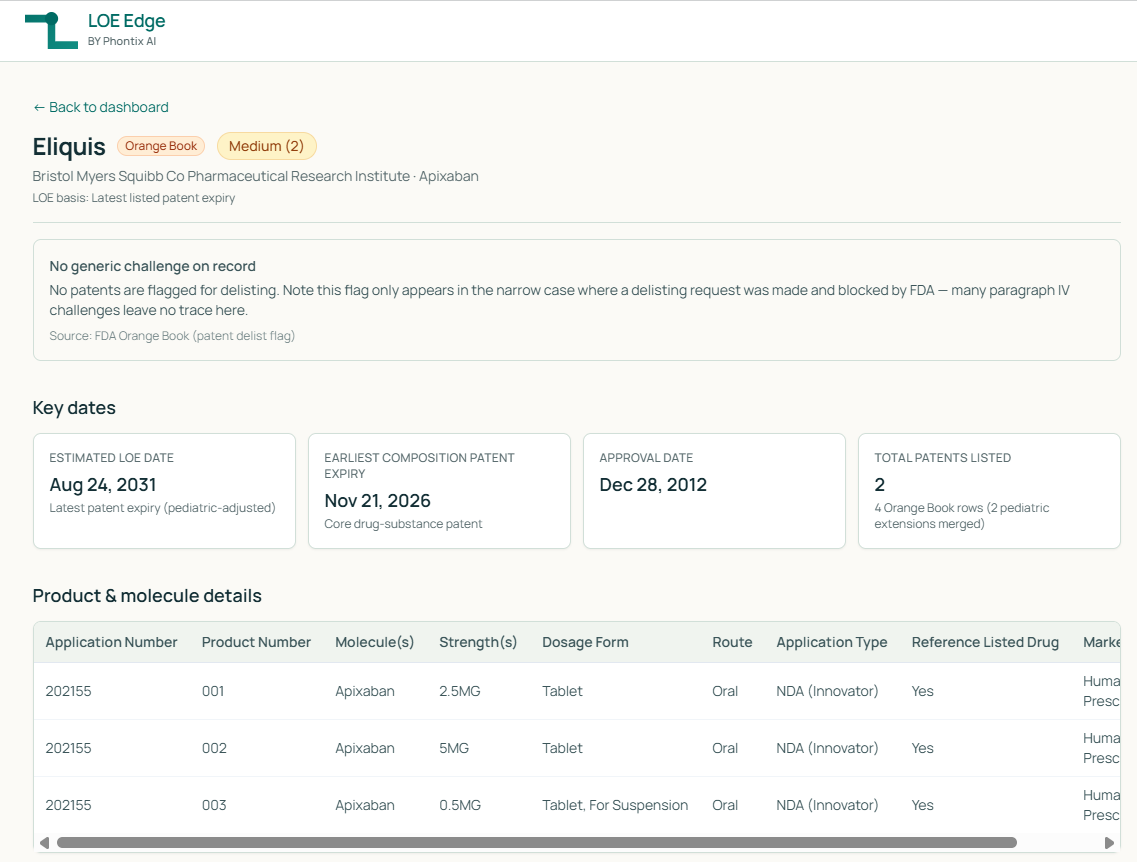
Compound, formulation, device and regulatory layers laid out on one timeline, with the layer that actually sets the entry date highlighted.
Challenge activity
Generic and biosimilar challenge status on record, with what is and is not publicly known stated plainly.
Biologics and biosimilars
Reference product exclusivity for biologics, kept separate from patent-based dates rather than mixed with them.
Opportunity forecast to 2035
Market sizing from patient population through to captured value, using demand, epidemiology and analog methods as the data allows.
US, EU5 and India
Jurisdiction comparison across the markets covered today, with further markets in build.
Molecule scoring
Benchmarking and scoring to rank molecules on opportunity, timing, crowding and evidence strength.
Evidence tier on every number
Tier 1 primary records, Tier 2 adjusted secondary data, Tier 3 modelled proxies, with automatic caps where models dominate.
Dossiers and exports
A PDF dossier per molecule, and structured exports for your own forecasting models.
How an opportunity estimate is built
Five stages, each owned by one module and read, never recalculated, by the stages after it. Uncertainty is carried forward stage by stage instead of averaged away.
True entry date
Protection decomposed into layers, because compound expiry is rarely when entry becomes possible.
Patient population
Built up from registry incidence and prevalence, filtered by subtype, stage and diagnosis.
Treatment reality
Guideline eligibility narrowed to what is actually prescribed in each market.
Volume and price
Dosing, duration and unit price, with list and net prices kept apart.
Capture
Post-exclusivity erosion and share, split by the routes an entrant uses to win patients.
Where the data comes from
We work from primary records wherever they exist: the issuing authority, the registry, the patent office. Commercial audit data is read under your own licence and never bought, stored or resold on your behalf.
- Markets today
- United States, EU5 (France, Germany, Italy, Spain, United Kingdom) and India
- Forecast horizon
- 2026 to 2035
- In build
- Further markets, prioritised by subscriber demand
Regulatory
Approval status, exclusivity, therapeutic equivalence and price control, from national authorities.
Patent and IP
Full-text patent records and legal status, searched by classification rather than simple lookup.
Scientific and epidemiological
Disease registries, peer-reviewed literature and international guideline bodies.
Commercial
Licensed audit and pipeline data, read only under your own subscription.
Primary research
Commissioned fieldwork where no published source exists: hospital audits, expert interviews, pricing surveys.
See a sample dossier
A worked molecule dossier shows the output format: timeline, challenge status, evidence tiers and the calculation trail.
Request a sample dossier: dupilumab in atopic dermatitis
Ask our team about the structure and evidence tiers of a worked example. This records a request; no sample PDF is available for automatic download here.
Discuss access to LOE Edge
Tell us about your team, markets and coverage needs. Contact our sales team to discuss pricing and the right access for you.
Talk to salesCommon questions about LOE Edge
Short answers. Ask on a demo call if you need the long ones.
What is loss of exclusivity?
Loss of exclusivity (LOE) is the point at which a medicine's patents and regulatory protections stop blocking competitors in a market, so generic or biosimilar versions can launch. It usually triggers fast price erosion and share loss for the originator.
Which markets does LOE Edge cover?
LOE Edge covers the United States, the EU5 (France, Germany, Italy, Spain and the United Kingdom) and India today. Each molecule record shows which markets are tracked and the register behind each entry. Further markets are in build.
How far ahead does LOE Edge forecast?
Opportunity forecasts run from 2026 to 2035. Challenge activity and status update as new filings become public, so the near-term view sharpens as an event approaches.
How is this different from a patent database?
A patent database tells you when a patent expires. LOE Edge tells you when a competitor can realistically launch, how large the opportunity is after entry, and how confident that estimate is, based on every layer of protection, the treatment reality in each market and how comparable molecules behaved.
Where does the data come from?
From primary records: regulators, patent offices, disease registries and peer-reviewed literature, plus commercial audit data you already license, which we read under your own subscription and never resell. Each input names its source and evidence tier.
Can we try LOE Edge before buying?
Yes. Explore the interactive demo or email info@phontixai.com to discuss a walkthrough and access for your team.
Can we export into our own models?
Yes. Structured Excel and CSV exports and PDF dossiers are part of every plan, built to drop into the forecasting models BD and portfolio teams already run.
See LOE Edge on your target list
We will run the demo against molecules you are evaluating or products you already sell, so you can judge the data on ground you know.